Send the request type, manufacturer, equipment model/year, part reference, ratings, quantity, destination, required date, and any drawing or photo notes. The SUVELL team will review the request.
Email: admin@suvell.com
Phone: +86 189 6871 1705
Factory: No.208 Wei 12 Rd, Yueqing Economic Development Zone, Wenzhou, Zhejiang, China
SF6 Load Break Switch vs Vacuum Circuit Breaker: Where Each Fits in MV Switchgear
SF6 load break switches and vacuum circuit breakers serve different duties in MV switchgear. This comparison explains load switching, fuse-based protection, and relay-operated fault interruption, then identifies the panel, control, and rating information needed to choose the appropriate device category for a feeder.
A load break switch handles its documented load-switching duty; a vacuum circuit breaker provides fault interruption within a protection scheme.
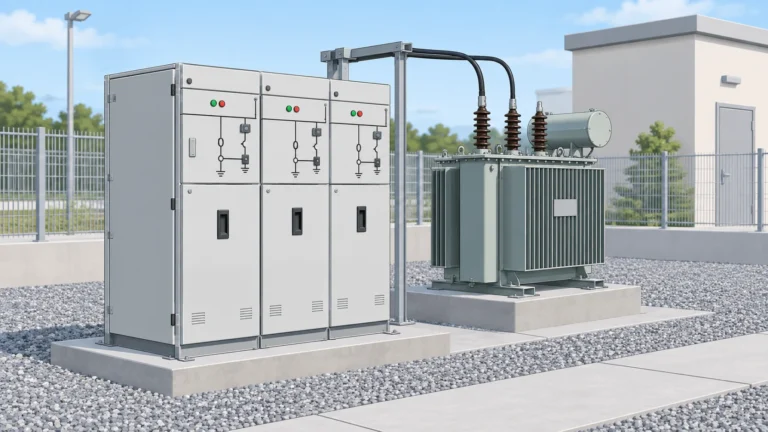
Transformer feeders may use a coordinated fuse-switch arrangement or relay-operated breaker protection, depending on the required duty and panel design.
Specify device function, protection interfaces, and manufacturer ratings explicitly; the words SF6 and vacuum alone do not establish application suitability.
In medium-voltage switchgear, the comparison of an **SF6 load break switch vs vacuum circuit breaker** is not a simple choice between two interchangeable devices. They are selected for different switching duties, protection philosophies, panel architectures, and system requirements. The practical boundary is this: an SF6 load break switch is commonly applied for load switching and isolation duties, often combined with fuses for specific protection functions, while a vacuum circuit breaker is used where the switchgear must interrupt fault current as part of a protection scheme.
For buyers evaluating MV Switching Devices, the key question is not “Which technology is better?” but “Which device is assigned to which duty in this medium-voltage system?” ABB’s medium-voltage guidance distinguishes switch disconnectors from circuit breakers by fault-current clearing capability. It also describes switch-disconnector applications such as line switching and transformer or motor switching when coordinated with fuses. Separately, ABB describes medium-voltage vacuum circuit breakers as protection devices that interrupt power flow when grid anomalies occur, while emphasizing that a switch disconnector does not interrupt fault current.
That distinction defines the application boundary.
Core Difference: Switching Duty vs Protection Duty
An SF6 load break switch and a vacuum circuit breaker may both appear in MV switchgear lineups, but they are not assigned the same primary responsibility.
An SF6 load break switch is intended for controlled switching of load current under defined operating conditions. It can open and close circuits during normal service switching operations and provide a visible or functionally defined isolation role depending on the switchgear design. In many MV distribution arrangements, it is used for feeder sectionalizing, ring main unit switching, transformer switching, and similar network operations.
A vacuum circuit breaker, by contrast, is selected when the switchgear must interrupt abnormal current under relay command. It forms part of a protection system: current transformers detect abnormal conditions, protective relays evaluate them, and the breaker opens to interrupt power flow. This is why circuit breakers are used where fault-current interruption is required.
The practical comparison is therefore:
Evaluation point
SF6 load break switch
Vacuum circuit breaker
Main role
Load switching and isolation duty
Protection switching and fault interruption
Fault-current clearing
Not the primary function of a switch disconnector
Core function when applied with protection system
Typical protection pairing
Often coordinated with fuses for transformer or motor applications
Coordinated with relays, CTs, trip circuits, and protection logic
Common MV use
Ring networks, load feeders, transformer feeders with fuses, sectionalizing
First, both devices can be installed inside MV switchgear. A buyer may see them as alternative “switching components,” but switchgear components are selected by duty, not by appearance.
Second, both may be used to control power flow. However, normal load switching and fault-current interruption are different engineering tasks.
Third, terminology can blur the boundary. “SF6 switch,” “load break switch,” “switch disconnector,” “vacuum breaker,” and “circuit breaker” may be used loosely in procurement conversations. The safer approach is to record the equipment family, insulation medium, switching or interruption method, ratings, and intended system duty rather than infer capability from a generic name.
ABB’s documentation on MV switching equipment also supports this caution: vacuum and SF6 circuit breakers have different construction and application characteristics, and component technology cannot be judged independently from system duty and ratings.
Where an SF6 Load Break Switch Fits
An SF6 load break switch fits applications where the required operation is switching load current and providing sectionalizing or isolation within the intended switchgear design. In medium-voltage distribution systems, it is commonly considered for compact switchgear, ring main units, secondary distribution networks, and transformer feeder arrangements.
ABB identifies switch-disconnector applications including line switching and transformer or motor switching with fuses. This is an important boundary: when fuses are used, they are part of the protection concept. The load break switch performs switching and isolation duties, while the fuse addresses fault interruption within its coordinated application.
This makes the SF6 load break switch a practical choice where the design goal is compact MV switching, operational simplicity, and defined load switching duty rather than full breaker-based protection on every feeder.
Application Boundary for SF6 Load Break Switches
An SF6 load break switch should be evaluated where the feeder duty is compatible with load switching and where the protection concept is clearly defined. Typical consideration points include:
Whether the feeder requires normal load switching rather than breaker-based fault clearing.
Whether fuse protection is part of the transformer or motor feeder design.
Whether the switchgear architecture is a ring main unit, compact distribution panel, or sectionalizing arrangement.
Whether the switching device is part of gas-insulated equipment or another switchgear family.
Whether the equipment documentation clearly identifies the insulation medium and breaking arrangement.
A critical procurement point is that “SF6” may refer to the insulation environment, the switching chamber, or the broader gas-insulated switchgear family. The equipment family and switching arrangement should be recorded from the manufacturer’s documentation rather than assumed from the device name.
Where a Vacuum Circuit Breaker Fits
A vacuum circuit breaker fits applications where the MV switchgear must interrupt current during abnormal system conditions. ABB describes medium-voltage vacuum circuit breakers as protection devices that interrupt power flow when grid anomalies occur. This is the fundamental reason VCBs are used in primary distribution switchgear, industrial MV panels, utility substations, and feeders requiring relay-based protection.
A vacuum circuit breaker is not simply a “stronger load switch.” It is a protective switching device that must be integrated with the full protection chain. That chain typically includes sensing, relay logic, trip power, mechanical operation, interlocking, and coordination with upstream and downstream devices.
Application Boundary for Vacuum Circuit Breakers
A vacuum circuit breaker should be evaluated where the feeder or incomer requires circuit-breaker duty, especially when fault-current interruption is assigned to the switchgear device itself. Common decision factors include:
Whether the switchgear must clear short-circuit or abnormal current through breaker operation.
Whether protective relays are required for the feeder.
Whether the feeder serves critical loads or requires adjustable protection logic.
Whether upstream and downstream coordination depends on breaker tripping.
Whether the panel design supports breaker withdrawal, isolation, interlocking, and test positions if applicable to the selected switchgear type.
The breaker selection must be tied to the system study and manufacturer ratings. It should not be selected only because “vacuum” is perceived as preferable or because the device is physically similar to another MV switching component.
Comparison in MV Switchgear Selection
When comparing an SF6 load break switch vs vacuum circuit breaker, the correct selection path starts with system duty.
If the feeder is a distribution branch that only needs load switching and sectionalizing, an SF6 load break switch may be appropriate. If the feeder needs fault clearing through a trip command from a protection relay, a vacuum circuit breaker is the appropriate category to consider.
This boundary becomes especially important in transformer feeder applications. A load break switch with fuses may be a valid architecture when the fuse-switch combination is designed and coordinated for that duty. A vacuum circuit breaker may be selected instead when relay-based protection, operational flexibility, or breaker interruption duty is required. These are different protection philosophies, not merely different component brands.
Buyer Checklist for Device Selection
Before specifying either device, buyers should confirm the following:
1. **Switching duty**: Is the device expected to switch load current only, or interrupt fault current?
2. **Protection method**: Is protection provided by fuses, relays and breaker tripping, or another coordinated system?
3. **Panel architecture**: Is the switchgear an RMU, compact secondary distribution unit, metal-enclosed panel, or primary switchgear lineup?
4. **Insulation and interruption arrangement**: Does the documentation identify SF6 gas-insulated equipment, SF6 load breaking, vacuum interruption, or another arrangement?
5. **Coordination requirements**: Has the device been selected according to the system protection philosophy rather than as a universal substitute?
6. **Manufacturer ratings and application notes**: Do the rated duties match the actual MV system requirements?
7. **Maintenance and lifecycle policy**: Does the site have preferences or restrictions related to gas handling, spare parts, operating mechanisms, or service practices?
Why Technology Alone Is Not Enough
A common mistake is to compare “SF6” and “vacuum” as if each word fully defines the device. It does not.
SF6 may describe an insulation medium in gas-insulated switchgear, a load-break switching arrangement, or part of a circuit breaker design. Vacuum usually describes the interruption medium inside a vacuum interrupter, but the complete breaker also includes the operating mechanism, insulation structure, embedded poles or assemblies, auxiliary circuits, and panel integration.
ABB’s application guidance notes that vacuum and SF6 circuit breakers have different construction and application characteristics, and that component technology cannot be compared independently of system duty and ratings. The same principle applies when comparing load break switches with circuit breakers. The buyer must compare the complete switching device in its intended switchgear system, not only the interruption or insulation medium.
Documentation Details That Should Not Be Assumed
Procurement documents should avoid ambiguous device descriptions. Instead of requesting only an “SF6 switch” or “vacuum switch,” the specification should identify:
Switchgear family: gas-insulated, air-insulated, compact RMU, metal-enclosed, or other arrangement.
Manufacturer documentation: rated performance and operating conditions.
This is especially important because modern switchgear portfolios may include gas-insulated switchgear as one equipment context and puffer-type load-break switching in other product families. The insulation and breaking arrangement should be recorded from the actual product documentation.
Practical Selection Scenarios
For a ring distribution network, an SF6 load break switch may fit where operators need to open, close, and sectionalize feeders under normal load conditions. If transformer feeders are included, the switch may be coordinated with fuses where the equipment design supports that protection approach.
For a primary distribution feeder serving a critical industrial process, a vacuum circuit breaker may be preferred where relay-based protection, trip logic, and fault interruption are required. The breaker can be integrated into a protection scheme that responds to abnormal current conditions.
For a transformer feeder, either architecture may appear in real projects, but the boundary must be explicit. A fuse-switch combination and a relay-operated circuit breaker are not the same protection concept. The correct choice depends on transformer size, network design, protection coordination, operating policy, and the switchgear manufacturer’s rated application.
For motor switching, ABB identifies switch-disconnector applications with fuses, but buyers should verify motor duty, switching frequency, protection requirements, and the manufacturer’s stated application limits. A device should not be assumed suitable for motor duty without checking the relevant switchgear documentation.
Commercial Considerations for MVSpare Buyers
In the consideration stage, buyers are usually comparing function, compatibility, and replacement risk. The safest approach is to begin with the installed switchgear and the required feeder duty.
For an SF6 load break switch, confirm the original panel type, operating mechanism, interlock arrangement, earthing switch configuration if applicable, auxiliary contacts, shaft and handle interface, and fuse arrangement if used.
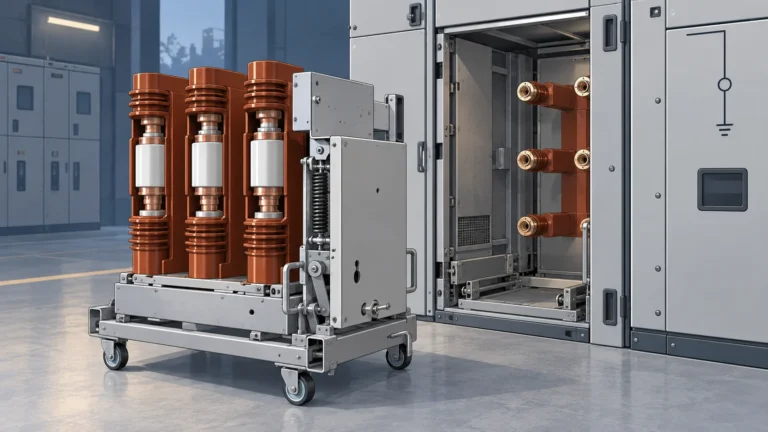
For a vacuum circuit breaker, confirm the breaker type, panel compatibility, primary contact arrangement, racking or fixed installation design, trip and closing coil requirements, auxiliary circuits, interlocks, and protection interface.
In both cases, MV switchgear replacement parts should be selected by documented compatibility. The nameplate, drawings, switchgear model, and original device designation are more reliable than a generic technology label.
FAQ
What is the main difference between an SF6 load break switch and a vacuum circuit breaker?
The main difference is the assigned switching duty. An SF6 load break switch is used for load switching and isolation duties under defined operating conditions. A vacuum circuit breaker is used where the switchgear must interrupt current during abnormal conditions as part of a protection system. In short, the load break switch is not a universal replacement for a circuit breaker because a switch disconnector does not perform the same fault-current clearing role.
What is an SF6 load break switch used for in MV switchgear?
An SF6 load break switch is used for medium-voltage load switching, feeder sectionalizing, and transformer or motor switching applications where the design and protection arrangement support that duty. In transformer or motor applications, it may be coordinated with fuses as part of the protection concept. Its suitability depends on the switchgear family, ratings, and manufacturer documentation.
What is a vacuum circuit breaker used for in MV switchgear?
A vacuum circuit breaker is used where breaker-based protection is required. It interrupts power flow when abnormal grid or system conditions are detected through the protection system. It is typically applied with current transformers, protective relays, trip circuits, and coordination studies so that the breaker opens when the system requires fault clearing or protective isolation.
What is the role of fuses with a load break switch?
Fuses can provide the fault-interruption function in a coordinated fuse-switch arrangement, while the load break switch performs load switching and isolation duties. This architecture is common in certain transformer feeder and motor feeder applications, but it must be selected according to the equipment manufacturer’s application limits and the system protection requirements.
What is the risk of treating the two devices as interchangeable?
The risk is assigning the wrong device to the wrong duty. If a load break switch is specified where a circuit breaker is required, the switchgear may lack the intended breaker-based fault interruption function. If a circuit breaker is specified where a simpler load switching arrangement would be sufficient, the project may add unnecessary complexity. The correct comparison is based on duty, protection concept, ratings, and switchgear architecture—not on technology name alone.
LEO Chen
With more than 20 years of industry experience, LEO Chen has worked with major companies on switchgear, transformer components and medium-voltage equipment projects. He contributes practical guidance for engineers and sourcing teams, with a focus on clear selection criteria, application context and the information needed to prepare an informed RFQ. Connect with LEO on LinkedIn.